Showing posts with label Sustainability. Show all posts

Sunday, 16 June 2013

Frankfurt - Hauptstadt des Fairen Handels?

Kalakosh's Heimat Frankfurt ist bekannt als Bankenstadt und auch letzten Tagen in Schlagzeilen wegen Blockupy Demonstration, aber Fair Handel und Frankfurt, passen sie zusammen?

Jawohl! Frankfurt ist seit 2011 eine vom ca. 1200 Fair Trade Towns in der Welt. Mehr Information Fair Trade Town Frankfurt.

Aber jetzt wirbt Frankfurt für Hauptstadt des Fairen Handels. Am 10.06.2013 war das "Kick-Off" vom Wettbewerb im Haus am Dom und da haben die Steuerungsgruppe die vorgesehen Projekten vorgestellt. Die Informationen findet ihr u. Hauptstadt des Fairhandels Wettbewerb.


Wir drücken die Daumen für unser Heimat!


Tuesday, 4 June 2013

Nach zwei Jahren...

Als wir Wellpaper zum ersten Mal in April 2011 besuchten, hatten wir das "Auro" ovaler Korb gekauft. Wir wollten selbst probieren, ob die Qualität tatsächlich stimmt, wie es uns versprochen wurde. Damals haben wir den Korb in Badzimmer für unsere Kosmetik und Haarpflegeartikeln benutzt, um den Korb gegen Feuchtigkiet auch zu prüfen.

Nach zwei Jahren bleibt der Korb noch in unserem Badzimmer - glänzt so grün wie neu. Trotz höher Feuchtigkeit ist der Korb genau so stabil und fest wie vor zwei Jahren. Falls Sie jemals Zweifel an der Qualität hätten, fragen Sie uns - Sie werden die Ergebnisse selbst sehen können.


Friday, 29 March 2013

Visiting WELL women

Our beautiful upcycled baskets and coaster are made with love by WELL women. WELL Stands for Women's Empowerment through Local Livelihood.

In 2011, we spent about 10 days with the group and they treated us part of WELL family. In 2012 december, we made a short visit. When we reached the center, they received us with big smiles and hugs. It was like getting back to our own families. Devi, one of the supervisor had birthday that day. She went to temple and came back early as we were visiting.

Nancy with Mary and Devi

We went around and talking to the women and showing kalakosh flyers and catalogue. They were all excited to see the products they make in print. 


Since last year, they started one new group to make rolled baskets and coaster out of newspaper. 

After spending couple of hours, we left the women group with a promise that next time we will visit them for at least couple of days. 

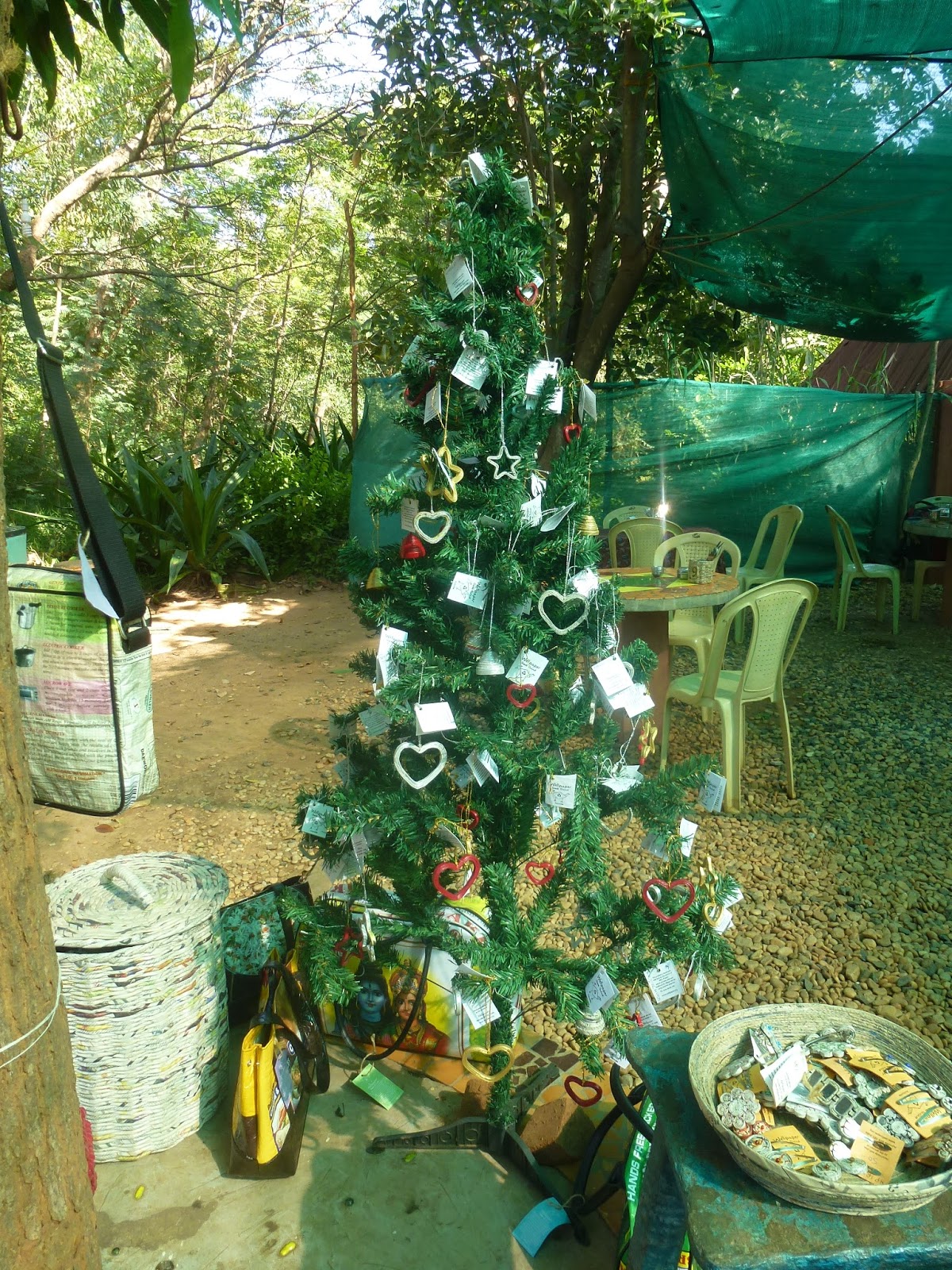
On the way back we stopped at Wellcafe to talk to Danny, founder of Wellpaper. We were happy to hear that they are getting good orders so that the women have enough work. Wellpaper products were nicely displayed at the Cafe including a decorated christmas tree.


Christmas tree decorated with wellpaper products


Sunday, 24 March 2013

Visiting our handmade paper artisans in Jaipur


Our beautiful handmade paper products that includes notebooks, gift wrapping papers, gift bags and greetings cards are made with love by artisans at Eco-Friendly Papers (EFP) in Jaipur. We visited them on 5th Dec 2012 to talk to the artisans and see how the products are made.

Nancy and I reached EFP office in Jaipur on 5th December around 10 am. After a quick greetings, we left for sanganer to visit the handmade paper factory. In the factory there are about 25 people working, out of that about 10 are women. The workers earn between Rs. 4000 to Rs. 8000 per month, depending on the skill and experience. They work from early morning 6 am to afternoon 2 pm. We spoke with one worker who learned the skill from his brother and has been working in the factory for about 4 years. He is very confident and proud of his work. He is also happy to have daily job so that he can take care of his family in the village. EFP is working with factory management to build water recycling unit to make the handmade paper making more sustainable.

Women working at handmade paper factory
 Women working at handmade paper factory

Handmade paper factory

Nancy and Vaibav (EFP) with owner of handmade paper factory

In sanganer we also visited screen printing workshop, where our gift wrapping papers are made. It is a small scale unit run by local entrepreneur and there are 6 people working in printing different designs to make beautiful gift wrapping paper. Here the workers earn between Rs. 4000 to Rs. 7000 per month depending on skills and experience. 


Screen printing artisans demonstrating the printing process

Gift wrapping paper with screen printed design


In the afternoon, we visited the production unit in Jaipur, where the finishing work on journals is done. There are about 30 people working and the salaries are between Rs. 4000 (house keeping) to Rs. 20,000 (managing director). 

We spoke with Sita, who has been working with EFP for more than 6 years. She comes from very traditional family where women wear scarf to cover their head and face. Initially when she started working at EFP, she was very hesitant to talk to strangers. After about 6 years, she manages 6 people who are making embroidery work on journals and coordinates the work with designers. She is very confident now and spoke very openly how she has changed in the last 6 years. She is also happy that by working at EFP, she could take care of her family and send her son to good school in Jaipur.

EFP artisan Sita

We also spoke with Bhavari, leather artisan who makes covers for our leather journals. Before joining EFP, he used to make leather shoes and because of multinational shoe companies they could not sell their traditional handmade leather shoes. At EFP, he uses his skills to make leather journal covers. He also works as interface between EFP and leather artisans in his village. Once the designs are finalised, he takes the raw material and designs to his village and get the leather covers done by the villagers in their homes. With this several women who are staying home to take care of their children can earn additional income. In total there are about 100 families who are working for EFP remotely from their homes.
Bhavari and team of leather artisans
Leather artisas demonstrating design on leather cover

EFP is also providing medical support for the employees and if there are any marriages in family they provide financial support. In all, people working there are happy being part of EFP family and proud of what they are creating.

Wednesday, 11 July 2012

Product Review : Multipurpose Basket


Durante mucho tiempo estuve buscando un cesto para ordenar mis set de maquillaje, los  cuales siempre estaban en todos lados, menos donde yo los buscaba cuando los necesitaba. Agraciadamente un buen amigo me regalo los cestos ovalados multiusos hechos de papel periodico reciclado de KALAKOSH. Al verlos era como si me hubieran leido el pensamiento, puesto que a mi parecer, estos cestos son muy practicos y sobretodo ecologicos. Gracias a los cestos multiusos no tengo que seguir buscando mi set de maquillaje, ahora todo esta en un lugar y donde yo lo necesito!!!

- Pamela Pizarro

Check more colors of the basket in kalakosh online shop

---------------------------------------------------------------------------------------------------------------------------------


I was looking for a basket in order to put in my make-up stuff, because they were all the time in different part of the house and I didn’t find them when I was looking for using them. One day I received the multi-purpose oval basket made from up cycled newspaper from KALAKOSH as a gift and I find them very useful.  Now all my Make-up stuff has a place and it is very practical. I don’t need to search for them any more!!! J
- Pamela Pizarro


Check more colors of the basket in kalakosh online shop

Sunday, 22 April 2012

Sustainable running choices

When we started with the idea of kalakosh to create a platform for sustainable life-style products, the discussion turned into how sustainable our life-styles are?

As i had been into running for about an year (My running blog), i started looking into the stuff around running to find out how sustainable it is and what changes i can do to make it more sustainable.

I started with the most important part of running, i.e. shoes. There i found a very interesting and innovative technology developed by Brooks, called BioMogo.


The ideology of brooks to share the technology to other shoe manufacturers to make the the running more sustainable is pretty cool.

To quote Brooks President and CEO Jim Weber on brooks values

“In our quest to make best-in-class performance products for runners, we also affect people and the environment as we process materials, contract with factories, and ship products around the globe. We care about healthy bodies and minds, and our role in fostering an environment where life can thrive for the long run. We are committed to evolving into a business that is more sustainable, one that builds great running gear with minimal impact on humanity and the Earth.”         

In Brooks, i found a company which is working consciously to make the running more sustainable. They also talk their principles more openly in all the forums, as a consumer it is very helpful in buying shoes.

PS : I am looking forward to buy my next brooks, Green Silence, which uses 75% recycled materials.

Sunday, 25 March 2012

Fair Trade: A Beginner's Guide by Jacqueline DeCarlo

I found this book when we started with the idea of kalakosh and trying to understand the world of fair trade. As such it is a great resource to start with if you are new to fair trade.

This book gives a comprehensive information about all topics related to fair trade. It starts with principles of fair trade and why it is important, continues on to the impact it can make on producer communities highlighted with examples or case studies related to some communities in South America. The author also narrates experiences of some individuals, who started fair trade initiatives - this makes for some very inspirational reading. Also, she touches upon how the latest technologies can take fair trade to a different level by connecting producers to consumers directly and engaging a broader audience.

The book ends with the future of fair trade from the author's perspective. In this context, the author highlights the fact that the fair trade movement is mostly run by the people from the "West" (implies developed countries), who are, in one way or the other, associated with religious organisations. It is now time for a new generation of entrepreneurs coming from different cultural backgrounds to get involved in fair trade businesses.

It is this "call to action" within the book that got us thinking about our own concept, which took the form of  kalakosh

We recommend this book to anyone, who is interested in fair trade and would like to know how it works. For this book or other related reading recommendations on fair trade, please check out our book collection under Fair Trade & Sustainability.

Sunday, 19 February 2012

Rural Women Empowerment: My Impressions - Part II

After spending a week with WELLpaper's women self help groups near Pondicherry, I travelled to the southern tip of India, Kanyakumari to visit the NGO CHARDEP.

CHARDEP is based in the town Nagercoil, which is about 2o km north of Kanyakumari. It is run by the very dedicated, highly motivated and down-to-earth Mr. Manikandan and his team. They have several following programs which include Annapoorna Yatra, where they provide a daily meal for the homeless in the region. Another program is the HIV/AIDS treatment center, where they have a small clinic to provide regular treatment for HIV infected people. They also have women empowerment programs, which was the my main reason for my visit to Nagercoil.

Currently there are about 1500 self-help groups (SHGs), which are supported/mentored by CHARDEP. CHARDEP makes sure that they get credit from the local bank using their resources as guarantee, they distribute the money and make sure that the money is paid back to the bank in time. All of these self-help groups are coordinated by an outstanding woman Mrs. Mary, who does not have any formal education but knows how to manages about 10,000 men and women from the villages. As a mentor and as a friend, she connects outstandingly well with the women in the SHGs.

The first SHG we visited is in a village reached driving from Kanyakumari to Nagercoil. The women there are making stripes out of palm tree leaves, which are then later used in making hats. It was an amazing sight to see about 15 women sitting under a tree on a sunny day laughing, talking and at the same working on the palm leaves. The working hours there are flexible as the women need to take care of their household chores, thereforce most of the women work about 4 to 6 hours daily. In addition to earning money for their livelihood, they are happy just being part of the group creating something good out of the locally available resources.

Women working under a tree

Stripes made out of palm tree leaves

The next SHG we visited is in another village which is about 10 km from the first village. As the entire region is full of palm trees, the second SHG is also working with palm tree leaves. They get the palm tree leaves, cut them in half and wave them to make a sheet/slab which is used as a construction material for a roof of a hut or a fencing wall. Different in this SHG is the fact that some of the women are entrepreneurs. They lease the palm trees yearly, so that they have the much needed raw material and rest of the byproducts they can sell locally.

The working hours are flexible in in this SHG as well, women work whenever they have time during the day. Some of the women I spoke to are using the income in sending their children to better schools and colleges. One of the woman was very proud that she could send her son to a technical college in nearby town.

Women explaining to us about their work (note palm leave sheets which are used as mats)

Women who was skillfully cutting the palm leave into two (I was astonished to see the precision of her work)

In both the SHGs, I was happy to see that given a chance women can make a great impact in the society and bring the much needed socio-economic transformation in rural india.

Sunday, 5 February 2012

Rural Women Empowerment: My Impressions - Part I

Recently I had the opportunity to visit some women’s self-help groups (SHGs) in India. Which was of course a great experience to see the the impacts of SHGs for women in rural India. Here are some of my notes and experiences from my visit.

Wellpaper:
In our online shop
Kalakosh, the beautiful baskets out of old newspapers (
"The Hindu"), are handmade by the women SHG of Wellpaper. WELL is the abbreviation of "Women Empowerment through Local Livelihood". Wellpaper was initiated in 2005 as a tsunami-relief effort to provide an alternative source of livelihood to the tsunami affected families in the region as well as to promote products made of recycled materials. Currently there are about 20 women divided into three groups working with Wellpaper. Wellpaper gives the orders to the groups and they also ensure that the groups have work around the year.

The groups act highly autonomously and the women are given the freedom to plan and to divide the production themselves. This include the planning, estimation of raw materials needed, ordering of raw materials and the division of the labour to make sure the products are finished on time. Before the women deliver the products to Wellpaper they then conduct a final quality check to ensure that no defective products are present. Although almost none of the woman have any formal education, their highly impressive product life cycle and their managing of the production is nothing less than a high quality formal production unit to be very proud of!

The women in the groups are treated equally and decisions are taken in a democratic way. Each woman has a role to fulfil and they are proud of creating these unique and beautiful products with their skills!
Visiting the women of Wellpaper every day for one week, I was taken in with this place full of these energetic and fun-loving women taking pride in their work.

Unfortunately, during my stay at Wellpaper the very strong
Cyclone Thane
devastated the entire region causing damages to most of the houses. The day after the cyclone hit the region, I was quite surprised to see that the women were back to work and they were laughing and having fun as usual, even though some of them got their houses damaged. It is very inspiring to see the resilience and the inner strength of these women.

Some visual impressions from my visit:

Aftermath of the cyclone - the damage is visible

Widespread destruction of infrastructure - many were left without electricity for days


Usha with a paper basket in the initial stages

Poorna here is working on the base of a basket

Work being done on paper jewellery


Shagila at work rolling together the newspapers in to thin reeds (seen in the background)

After a week of stay there, I am convinced that SHGs are playing a great role in improving the living conditions in the region through empowering women.
Notes from next SHG follows soon...

Saturday, 29 October 2011

Arvind Gupta: Turning Trash Into Toys For Learning

I watched this video a few months ago more in context of learning aids for primary education. Today I remembered it and I look at it through the prism of sustainability and re-usability. Arvind Gupta, the presenter, offers these simple "handmade" toys using readily available items like safety pins and match-sticks as learning aids for children in rural areas. These not only help in understanding basic science concepts, but also are fun, creative, and imaginative. Check out the doodling box for blind children - that's my pick.


Watching this video, I am also asking myself whether this is only about low cost learning aids for kids in rural areas. Wouldn't you take some of these ideas for doing some fun projects with kids around you...bringing art and science together? And a lesson in sustainability too, when the kids see that these toys can be made by re-using potential trash items like paper clips or old newspapers.

Tuesday, 18 October 2011

Importance of Choice

Came across this interview with Prof. Peter Singer in the German Retail Blog (of Lebensmittel Zeitung), which I wanted to share with you. Reading it, I felt it was quite a provocative interview - the interviewer trying to challenge Prof. Singer's views on ethics and Prof. Singer, in turn, challenging the audience to think differently. 

Reason for highlighting this interview here: there are a couple of thoughts in there I'd like to reproduce here, which also relates to what Kalakosh stands for.
"At the end of the day, you have a choice and can vote with your pocket. That determines what is going to be produced. Producers will only provide such food, if you keep buying it."
Lifestyle is about daily choices we make - some big, some small; some easy, some not so easy. As consumers, we are spoilt for choices - though I feel that we too often forget to exercise those choices consciously or conscientiously. Now, as I learn more and more, I realize what I have missed. 

Which brings me to the second thought from the interview:
"I very much doubt whether you will ever be that [a saint], but the important thing is not to say, “Well, I can’t be a saint, so I shall just throw up my hands in despair and won’t bother trying.” Instead, you should say to yourself: “Look, I can improve!” 
As consumers, despite the choices we have, it is easy to succumb to our favourite brands or to peer pressure or to the price tag - I am probably the best example of that. But I am learning that we can all make a difference - through any action, big or small. One doesn't need to be a saint.

So, after a bit of a philosophical post, I leave you with your thoughts ... remember, every decision you make counts!

post-script: if you are considering giving up meat as I am at this point, you might also wish to refer to our earlier post on the relative cost of consuming various food products in terms of carbon emissions.

Tuesday, 11 October 2011

school musing: part II

as promised, an extended review on the recycled and handmade paper journals, viz. notebooks and writing pads.

the cover of these very unique journals is made from pages of old school-notebooks, while the pages inside  are made with regular white handmade paper. the process that gives these a distinct look is the use of tea to give the covers their earthy brown tone. read: totally organic and sustainable and beautiful.


a word on the dimensions - the size of a big sketch book is around 8.5 in. x 11 in.  the small size book and journal come in the size 6 in. x 8 in. each. All of them include 48 handmade paper pages respectively.

the book fits the purpose of a savvy yet conscious business professional as well as a university student striving to make a difference. for one and all!

coming soon!

Saturday, 1 October 2011

school musing!

if i knew that out of my old school books something creative would be born, i probably would have handled my notebooks well, and perhaps been a little more attentive?

i was amazed and speechless, when i saw some of the fabulous creations that could be made out of old school notebooks. i am not sure that the little children who give their notebooks away also know that, journals and new notepads actually carry their handwriting on their front cover! what could be cooler than that!

the result: a motley of original writing art. every book unique, every bag different!

want a sneak picture peek? wait for my next post.

signing off for meraTierra,
k

Thursday, 29 September 2011

Recycled Paper Basket

We've been going through the products samples we have received in the last few days. We are all super excited to see the products first-hand and can't wait to get them to you. That's why we'll be putting out some of the pictures for you to see and get a feel for what kind of products and experiences we're preparing for you.


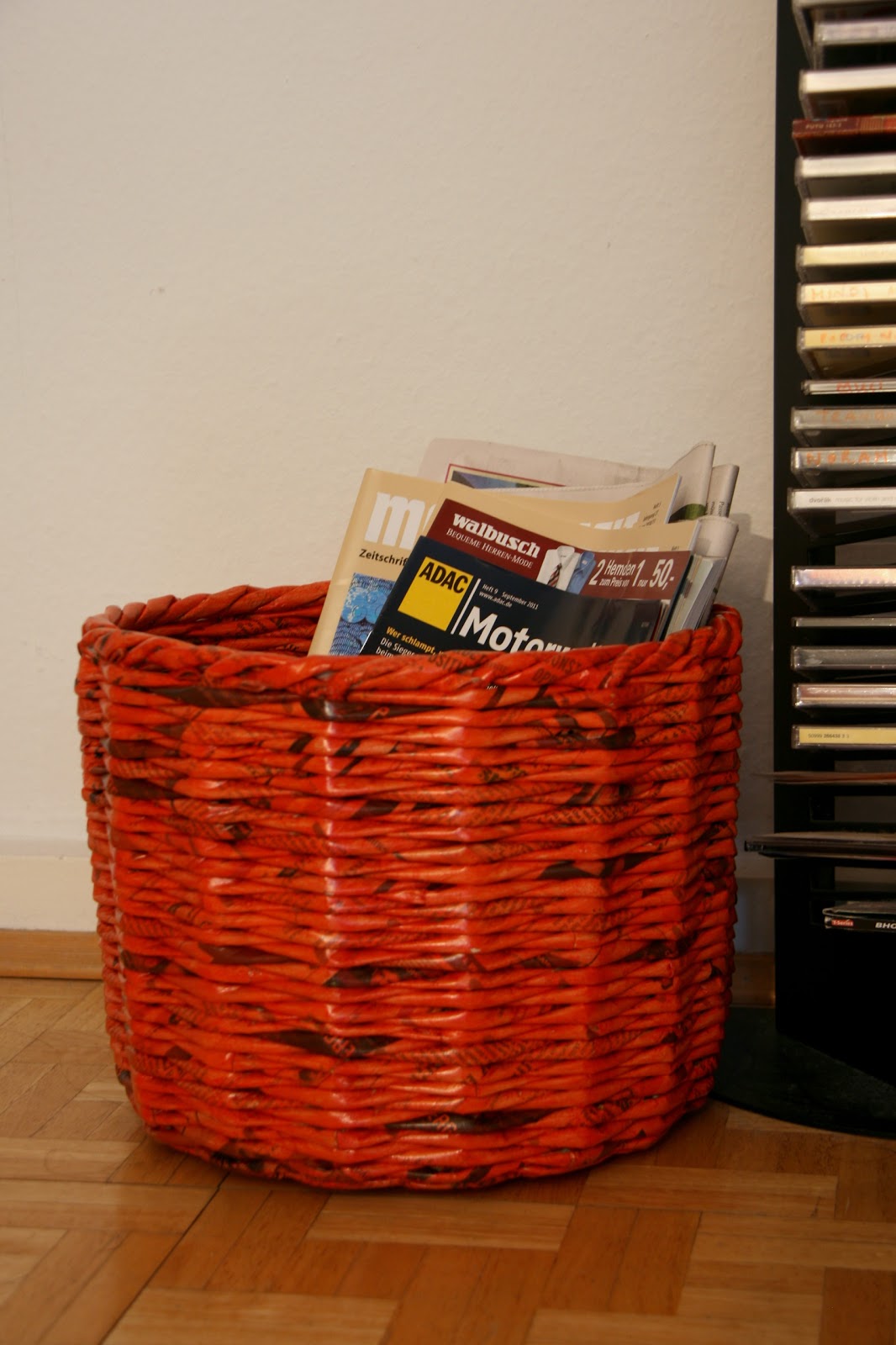
One of our favourite ones are the recycled paper baskets. Made from old newspapers, the paper is rolled in and then "woven" to create these baskets. In terms of look and feel, they look similar to the cane baskets...just a bit more cooler... :-) The basket will be available in three sizes - small, medium, and large (the one above is the large size).

The basket will be available in colours including red, orange, and blue. There is also a natural (uncoloured as the newspaper itself) version available.The colours used for the basket are essentially non-toxic inks (similar to those used in childrens' comics). 

The great thing is that these sturdy baskets are very much multi-purpose - for example, as waste paper bins, or as magazine/newspaper holders (as shown in the picture), or to hold all your craft material - pretty much anything and everything, which is not wet.

What do you think? Let us know...and stay tuned for more product previews.

Sunday, 28 August 2011

Carry Bags - Paper vs. Plastic

As a layman in the world of sustainable lifestyles, I instantly associate plastic with "not good" and paper with "good". If either is recycled, then "very good". The reason for this distinction is the conventional wisdom that plastic is not degradable ... or, to be more correct, takes forever to degrade.

So, I am actually intrigued, when I read about an Indian company called Biotec Bags in this article. Actually, I am not intrigued by the company - it is using "bio-degradable plastic" technology to make bags. The curious part is the comparison between paper and plastic bags on their website. The conclusion, quoted here from their website:
"Except the degradable period all other points are favoring Plastic bags than Paper bags. Since Bio degradable Plastic bags' degradable period is approximately 6 months only, Biodegradable Plastic is better in all aspects than paper and normal plastic bags." (Source: http://www.biotecbags.com/plasticmenace.php)
As I understand - normal plastic bags are better than paper bags, except for the degradability period. With bio-degradable plastics, even this disadvantage is nullified - suggesting that bio-degradable plastics should be the eco-friendly material of choice for, at least, carry bags.

Sadly, there are no references in this comparison to any research or study, which might have lent more credibility to that conclusion and driven some fact-based decision-making for consumers. And there is no information which can help gauge, how widespread is the use of bio-degradable plastics across the world, what are their applications (apart from carry bags), and so on. One reads about plastic bags being restricted or banned in many places - in more than 25% of the world, according to this entry in Wikipedia. (individual examples: here, here, here, or here). But is that a better solution in light of this information (assuming it is factually correct)? What about recycled plastic bags (as shown below)?


For me, I'd like to think that recycling to be the lesser of the evils - irrespective of whether it is paper or plastic. Maybe I'll be proven wrong someday with some new scientific study out there. Till then, I'll follow recycling in good faith.

The real lesson from this is: just carry your cloth bags or totes with you whenever and wherever you go shopping. Forget plastic or paper.

Please share any more information you may have on this topic - your thoughts on the same are most welcome.

Monday, 22 August 2011

A Case for Being A Herbivore

The first 20 years of my life, I was a hardcore vegeterian. Except for that one little incident in school when I decided to taste some boiled egg from Shailesh W's "dabba" (lunch box) - and, yes, where I come from, eggs are considered non-vegeterian. I incurred the envy of my sister and the wrath of my mum - two tight ones across the cheeks (after the first, I did not even need to offer the other cheek, as Gandhi proposed) and a house arrest later, I was wiser. Eggs, chicken, mutton ... all of it was off-limits.

At college, I rebelled (or experimented, depending on how you look at it). And it continues till this day. I am not a vegetarian anymore. But lately, I have been thinking about the arguments about how being vegeterian or vegan is environment-friendlier, and, possibly, healthier. You probably must have read about this somewhere...or heard about it from friends...or simply knew it intuitively (I don't think my mum or sister knew it that time either... but that's another story all together!)

Yesterday, I saw this graph on a blog post from Sustainable Dave. Originally based on an article from Scientific American, I think its probably one of the first pieces I have seen that actually quantifies the environmental price we pay for some our our diet choices... I thought this was quite creative.


Courtesy: Scientific American

Jokes apart, this does appeal to me to reduce my meat intake ... or rather, I think, it makes a good case for adopting a balanced diet. And isn't that what doctors have been telling us since like ... forever?

Your thoughts?

Thursday, 9 June 2011

What's the Mission - Fair Trade or Lifestyle?

As we worked on the concept, we often asked ourselves whether we'd like to be a fair trade store selling lifestyle products or whether we'd like to be a lifestyle store promoting fair trade. For some, the difference is not big between the two.

But there is, when you think about why anyone should be interested in buying our products. We want to offer irresistible and quality products to our customers and they will buy it - not because they are fairly traded, but simply because they are irresistible and quality products.

The way I am looking at this - it is almost a cycle. Use of terms like 'conscious consumption' suggest that the onus is on the consumer to make a 'conscious' decision while buying a product. But that approach excludes a significant majority of the population from fair and sustainable trade. This results in lower volumes, higher prices, and, in turn, lower consumption.

In a discussion with the owner of an organic food processing business in India, one of my questions on how an average Indian family of 4 can afford and benefit from organic food remained unanswered - suggestions around lower medical costs and conscious buying decisions were vague. All this in a time of high and volatile food prices. This is not to say that organic food is the wrong thing - it just means that any food product with its organic origins as its only USP is bound to remain outside the mainstream. That neither helps the cause nor the business.

Fair trade, ethics, sustainability - these are not meant to be privileges, but responsibilities. These should be inherent in what we do. It should not be a contrived effort, because that will result in cynical consumers - and cynicism is high out there, when it comes to these principles. The onus will always be on the manufacturers and retailers, not on the consumers, because they will go for what's the best for them.

Sometime back there was an excellent article on Subaru in Businessweek - it manages to invest resources in its recycling efforts only because its cars sell. For all the companies marketing their green credentials, most people buy their cars based on many other factors aside from the green technology. For a great car, it adds to the good feeling that it is green too - but for a bad car, nobody would care if its green or not.

So, there we are: we will be a lifestyle store promoting sustainability and fair trade. You'll find out soon about the irresistible products we are talking about in the next posts. Stay tuned!