Showing posts with label Fair Trade. Show all posts

Sunday, 16 June 2013

Frankfurt - Hauptstadt des Fairen Handels?

Kalakosh's Heimat Frankfurt ist bekannt als Bankenstadt und auch letzten Tagen in Schlagzeilen wegen Blockupy Demonstration, aber Fair Handel und Frankfurt, passen sie zusammen?

Jawohl! Frankfurt ist seit 2011 eine vom ca. 1200 Fair Trade Towns in der Welt. Mehr Information Fair Trade Town Frankfurt.

Aber jetzt wirbt Frankfurt für Hauptstadt des Fairen Handels. Am 10.06.2013 war das "Kick-Off" vom Wettbewerb im Haus am Dom und da haben die Steuerungsgruppe die vorgesehen Projekten vorgestellt. Die Informationen findet ihr u. Hauptstadt des Fairhandels Wettbewerb.


Wir drücken die Daumen für unser Heimat!


Tuesday, 4 June 2013

Nach zwei Jahren...

Als wir Wellpaper zum ersten Mal in April 2011 besuchten, hatten wir das "Auro" ovaler Korb gekauft. Wir wollten selbst probieren, ob die Qualität tatsächlich stimmt, wie es uns versprochen wurde. Damals haben wir den Korb in Badzimmer für unsere Kosmetik und Haarpflegeartikeln benutzt, um den Korb gegen Feuchtigkiet auch zu prüfen.

Nach zwei Jahren bleibt der Korb noch in unserem Badzimmer - glänzt so grün wie neu. Trotz höher Feuchtigkeit ist der Korb genau so stabil und fest wie vor zwei Jahren. Falls Sie jemals Zweifel an der Qualität hätten, fragen Sie uns - Sie werden die Ergebnisse selbst sehen können.


Friday, 29 March 2013

Visiting WELL women

Our beautiful upcycled baskets and coaster are made with love by WELL women. WELL Stands for Women's Empowerment through Local Livelihood.

In 2011, we spent about 10 days with the group and they treated us part of WELL family. In 2012 december, we made a short visit. When we reached the center, they received us with big smiles and hugs. It was like getting back to our own families. Devi, one of the supervisor had birthday that day. She went to temple and came back early as we were visiting.

Nancy with Mary and Devi

We went around and talking to the women and showing kalakosh flyers and catalogue. They were all excited to see the products they make in print. 


Since last year, they started one new group to make rolled baskets and coaster out of newspaper. 

After spending couple of hours, we left the women group with a promise that next time we will visit them for at least couple of days. 

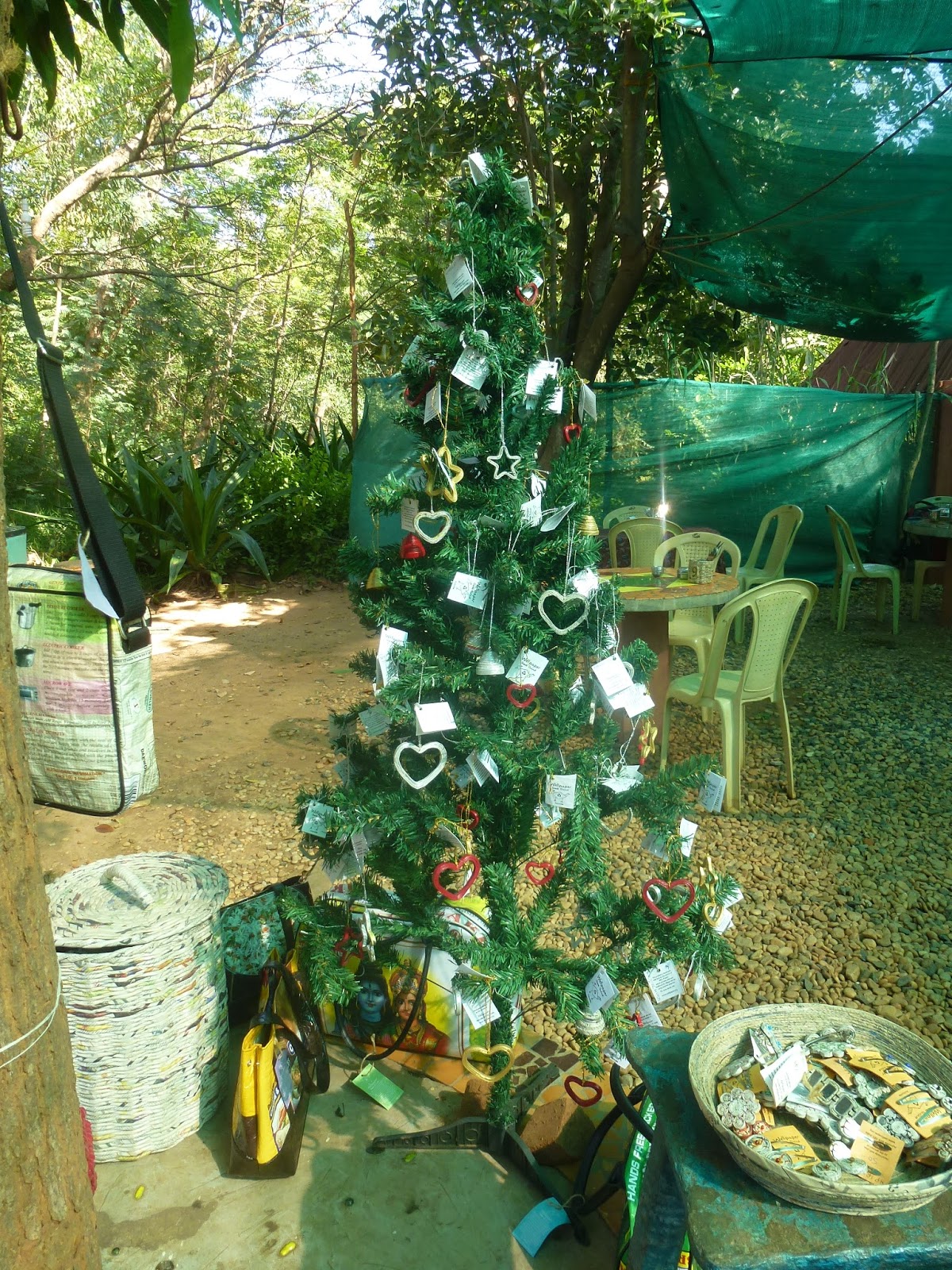
On the way back we stopped at Wellcafe to talk to Danny, founder of Wellpaper. We were happy to hear that they are getting good orders so that the women have enough work. Wellpaper products were nicely displayed at the Cafe including a decorated christmas tree.


Christmas tree decorated with wellpaper products


Sunday, 24 March 2013

Visiting our handmade paper artisans in Jaipur


Our beautiful handmade paper products that includes notebooks, gift wrapping papers, gift bags and greetings cards are made with love by artisans at Eco-Friendly Papers (EFP) in Jaipur. We visited them on 5th Dec 2012 to talk to the artisans and see how the products are made.

Nancy and I reached EFP office in Jaipur on 5th December around 10 am. After a quick greetings, we left for sanganer to visit the handmade paper factory. In the factory there are about 25 people working, out of that about 10 are women. The workers earn between Rs. 4000 to Rs. 8000 per month, depending on the skill and experience. They work from early morning 6 am to afternoon 2 pm. We spoke with one worker who learned the skill from his brother and has been working in the factory for about 4 years. He is very confident and proud of his work. He is also happy to have daily job so that he can take care of his family in the village. EFP is working with factory management to build water recycling unit to make the handmade paper making more sustainable.

Women working at handmade paper factory
 Women working at handmade paper factory

Handmade paper factory

Nancy and Vaibav (EFP) with owner of handmade paper factory

In sanganer we also visited screen printing workshop, where our gift wrapping papers are made. It is a small scale unit run by local entrepreneur and there are 6 people working in printing different designs to make beautiful gift wrapping paper. Here the workers earn between Rs. 4000 to Rs. 7000 per month depending on skills and experience. 


Screen printing artisans demonstrating the printing process

Gift wrapping paper with screen printed design


In the afternoon, we visited the production unit in Jaipur, where the finishing work on journals is done. There are about 30 people working and the salaries are between Rs. 4000 (house keeping) to Rs. 20,000 (managing director). 

We spoke with Sita, who has been working with EFP for more than 6 years. She comes from very traditional family where women wear scarf to cover their head and face. Initially when she started working at EFP, she was very hesitant to talk to strangers. After about 6 years, she manages 6 people who are making embroidery work on journals and coordinates the work with designers. She is very confident now and spoke very openly how she has changed in the last 6 years. She is also happy that by working at EFP, she could take care of her family and send her son to good school in Jaipur.

EFP artisan Sita

We also spoke with Bhavari, leather artisan who makes covers for our leather journals. Before joining EFP, he used to make leather shoes and because of multinational shoe companies they could not sell their traditional handmade leather shoes. At EFP, he uses his skills to make leather journal covers. He also works as interface between EFP and leather artisans in his village. Once the designs are finalised, he takes the raw material and designs to his village and get the leather covers done by the villagers in their homes. With this several women who are staying home to take care of their children can earn additional income. In total there are about 100 families who are working for EFP remotely from their homes.
Bhavari and team of leather artisans
Leather artisas demonstrating design on leather cover

EFP is also providing medical support for the employees and if there are any marriages in family they provide financial support. In all, people working there are happy being part of EFP family and proud of what they are creating.

Sunday, 25 March 2012

Fair Trade: A Beginner's Guide by Jacqueline DeCarlo

I found this book when we started with the idea of kalakosh and trying to understand the world of fair trade. As such it is a great resource to start with if you are new to fair trade.

This book gives a comprehensive information about all topics related to fair trade. It starts with principles of fair trade and why it is important, continues on to the impact it can make on producer communities highlighted with examples or case studies related to some communities in South America. The author also narrates experiences of some individuals, who started fair trade initiatives - this makes for some very inspirational reading. Also, she touches upon how the latest technologies can take fair trade to a different level by connecting producers to consumers directly and engaging a broader audience.

The book ends with the future of fair trade from the author's perspective. In this context, the author highlights the fact that the fair trade movement is mostly run by the people from the "West" (implies developed countries), who are, in one way or the other, associated with religious organisations. It is now time for a new generation of entrepreneurs coming from different cultural backgrounds to get involved in fair trade businesses.

It is this "call to action" within the book that got us thinking about our own concept, which took the form of  kalakosh

We recommend this book to anyone, who is interested in fair trade and would like to know how it works. For this book or other related reading recommendations on fair trade, please check out our book collection under Fair Trade & Sustainability.

Tuesday, 18 October 2011

Importance of Choice

Came across this interview with Prof. Peter Singer in the German Retail Blog (of Lebensmittel Zeitung), which I wanted to share with you. Reading it, I felt it was quite a provocative interview - the interviewer trying to challenge Prof. Singer's views on ethics and Prof. Singer, in turn, challenging the audience to think differently. 

Reason for highlighting this interview here: there are a couple of thoughts in there I'd like to reproduce here, which also relates to what Kalakosh stands for.
"At the end of the day, you have a choice and can vote with your pocket. That determines what is going to be produced. Producers will only provide such food, if you keep buying it."
Lifestyle is about daily choices we make - some big, some small; some easy, some not so easy. As consumers, we are spoilt for choices - though I feel that we too often forget to exercise those choices consciously or conscientiously. Now, as I learn more and more, I realize what I have missed. 

Which brings me to the second thought from the interview:
"I very much doubt whether you will ever be that [a saint], but the important thing is not to say, “Well, I can’t be a saint, so I shall just throw up my hands in despair and won’t bother trying.” Instead, you should say to yourself: “Look, I can improve!” 
As consumers, despite the choices we have, it is easy to succumb to our favourite brands or to peer pressure or to the price tag - I am probably the best example of that. But I am learning that we can all make a difference - through any action, big or small. One doesn't need to be a saint.

So, after a bit of a philosophical post, I leave you with your thoughts ... remember, every decision you make counts!

post-script: if you are considering giving up meat as I am at this point, you might also wish to refer to our earlier post on the relative cost of consuming various food products in terms of carbon emissions.

Thursday, 9 June 2011

What's the Mission - Fair Trade or Lifestyle?

As we worked on the concept, we often asked ourselves whether we'd like to be a fair trade store selling lifestyle products or whether we'd like to be a lifestyle store promoting fair trade. For some, the difference is not big between the two.

But there is, when you think about why anyone should be interested in buying our products. We want to offer irresistible and quality products to our customers and they will buy it - not because they are fairly traded, but simply because they are irresistible and quality products.

The way I am looking at this - it is almost a cycle. Use of terms like 'conscious consumption' suggest that the onus is on the consumer to make a 'conscious' decision while buying a product. But that approach excludes a significant majority of the population from fair and sustainable trade. This results in lower volumes, higher prices, and, in turn, lower consumption.

In a discussion with the owner of an organic food processing business in India, one of my questions on how an average Indian family of 4 can afford and benefit from organic food remained unanswered - suggestions around lower medical costs and conscious buying decisions were vague. All this in a time of high and volatile food prices. This is not to say that organic food is the wrong thing - it just means that any food product with its organic origins as its only USP is bound to remain outside the mainstream. That neither helps the cause nor the business.

Fair trade, ethics, sustainability - these are not meant to be privileges, but responsibilities. These should be inherent in what we do. It should not be a contrived effort, because that will result in cynical consumers - and cynicism is high out there, when it comes to these principles. The onus will always be on the manufacturers and retailers, not on the consumers, because they will go for what's the best for them.

Sometime back there was an excellent article on Subaru in Businessweek - it manages to invest resources in its recycling efforts only because its cars sell. For all the companies marketing their green credentials, most people buy their cars based on many other factors aside from the green technology. For a great car, it adds to the good feeling that it is green too - but for a bad car, nobody would care if its green or not.

So, there we are: we will be a lifestyle store promoting sustainability and fair trade. You'll find out soon about the irresistible products we are talking about in the next posts. Stay tuned!